Alpha v0.6.0 · free & open source

Local AI layers,
inside Photoshop.

OpenLayer connects Photoshop to your own ComfyUI server. Generate with Stable Diffusion, SDXL, and Flux — then import results as editable layers. Your art, your GPU, your machine. No cloud. No credits. No subscription.

  • 100% local
  • Open source · MIT
  • Photoshop 2024+
  • ComfyUI powered
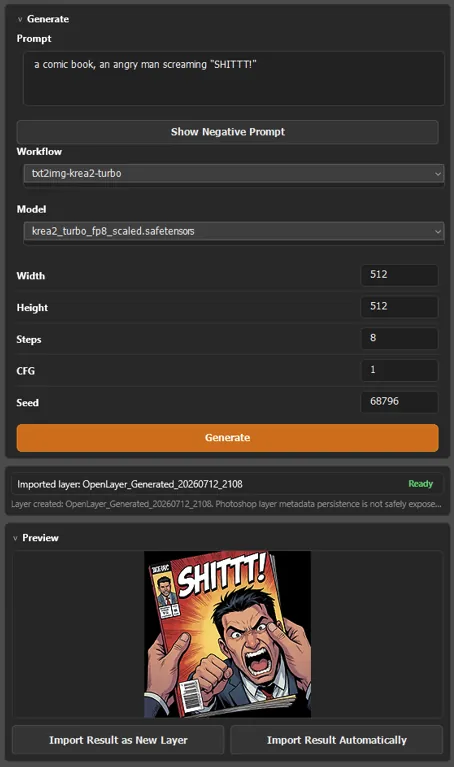
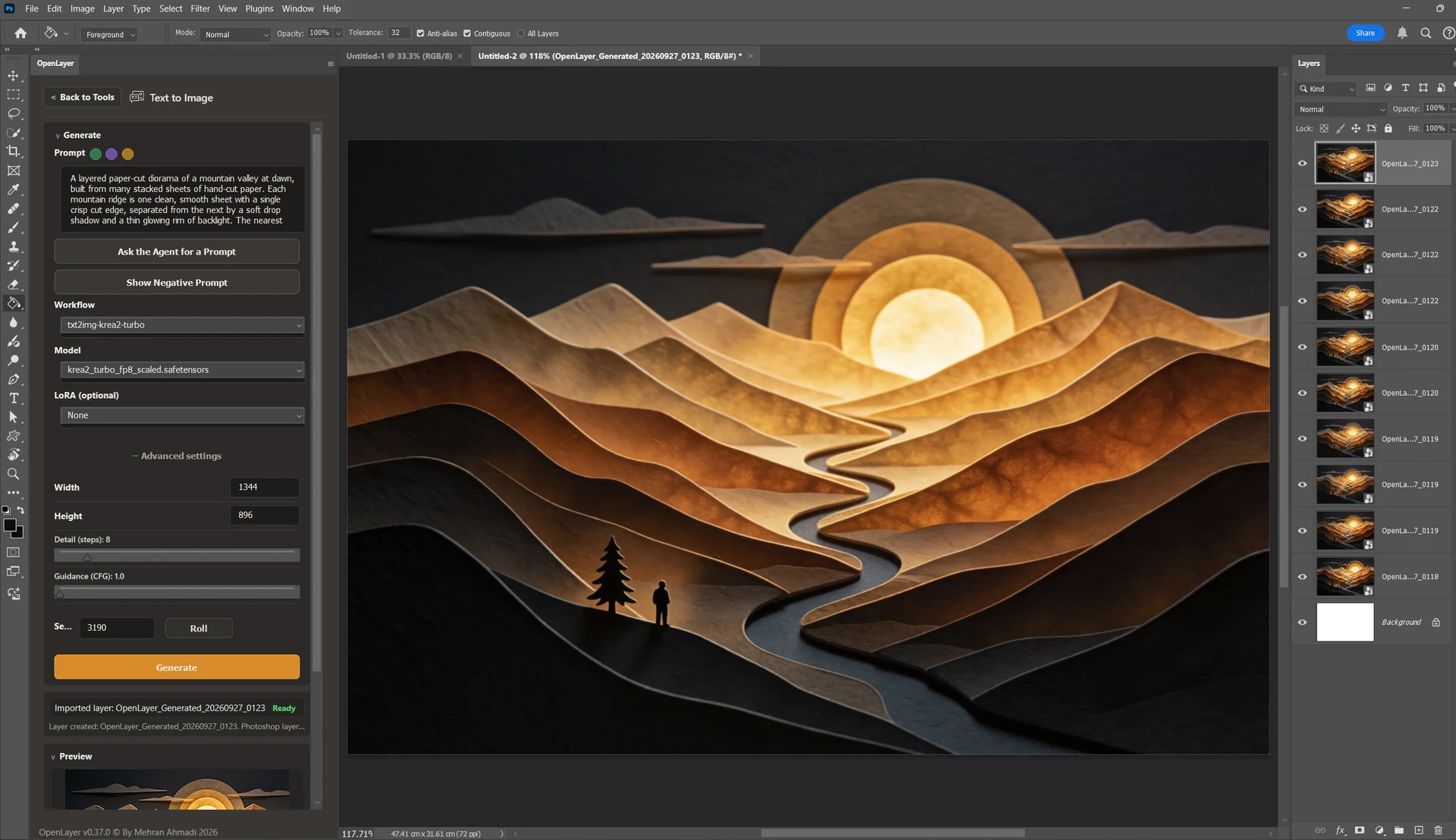
OpenLayer v0.6 Text to Image generating and importing a comic-style result inside Adobe Photoshop.
Text to Image, where the work happens. Generate locally, preview in OpenLayer, and keep every result as an editable Photoshop layer.

v0.6 artist-first interface

Local generation that now feels at home inside Photoshop.

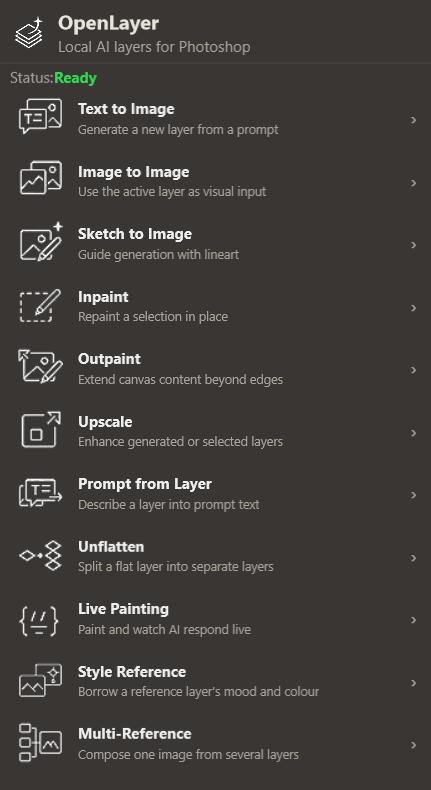
OpenLayer starts with dependable local workflows — text to image, image to image, sketch to image, experimental inpaint and outpaint, pixel upscale, lossless PNG source capture, live previews, diagnostics, and clean import into the active document. v0.6 adds a denser Adobe-style launcher, sticky tool headers, real generation progress, clearer availability states, and UXP-safe prompt editing without hiding the experimental edges.

Tools

What works now

Text to Image

Stable

Prompt, negative prompt, size, steps, CFG, and seed into your checkpoint of choice — SD 1.x, SDXL, plus experimental Flux fp8 and Z-Image-Turbo presets.

Image to Image

Stable

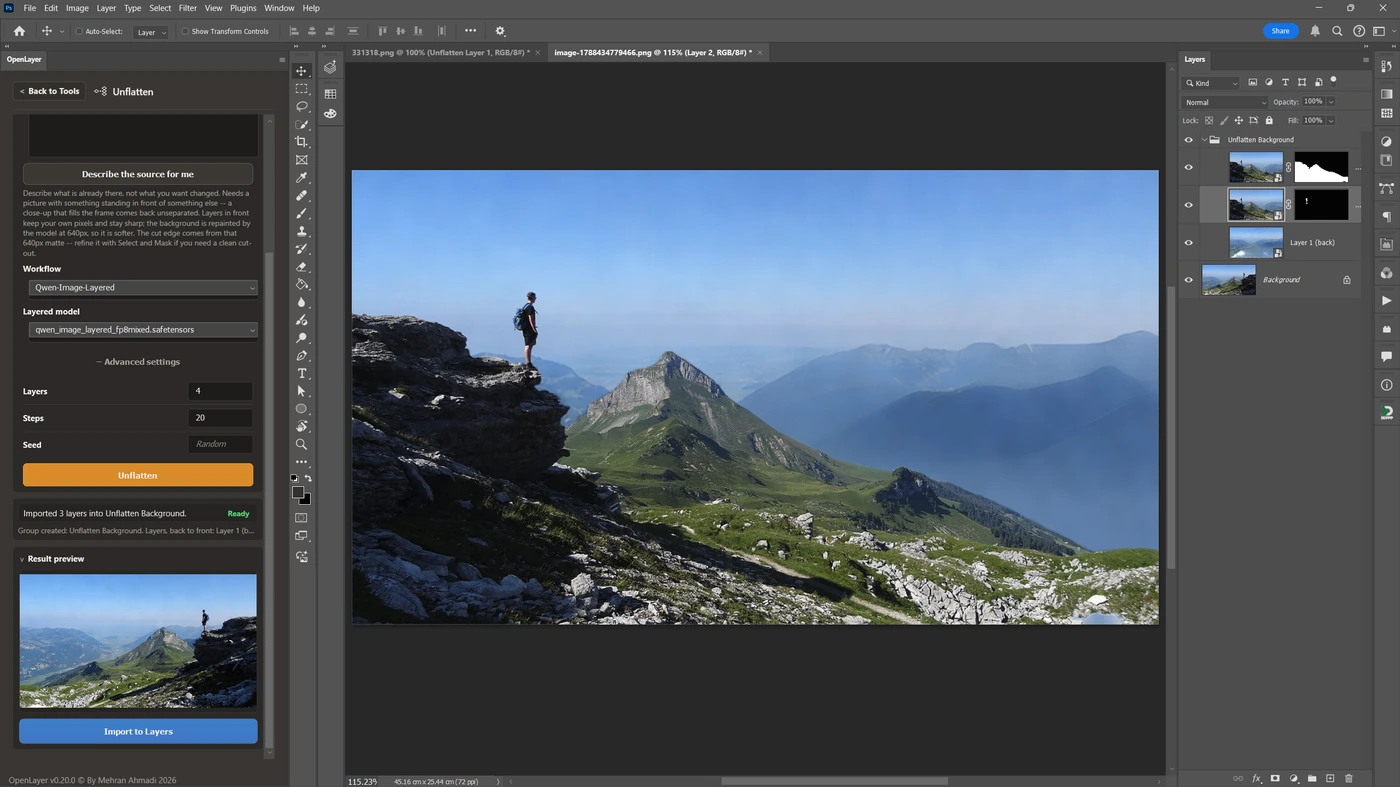
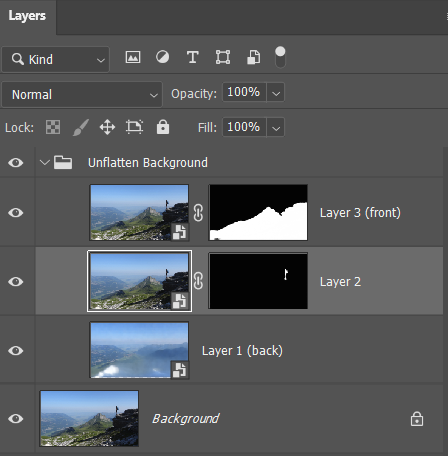
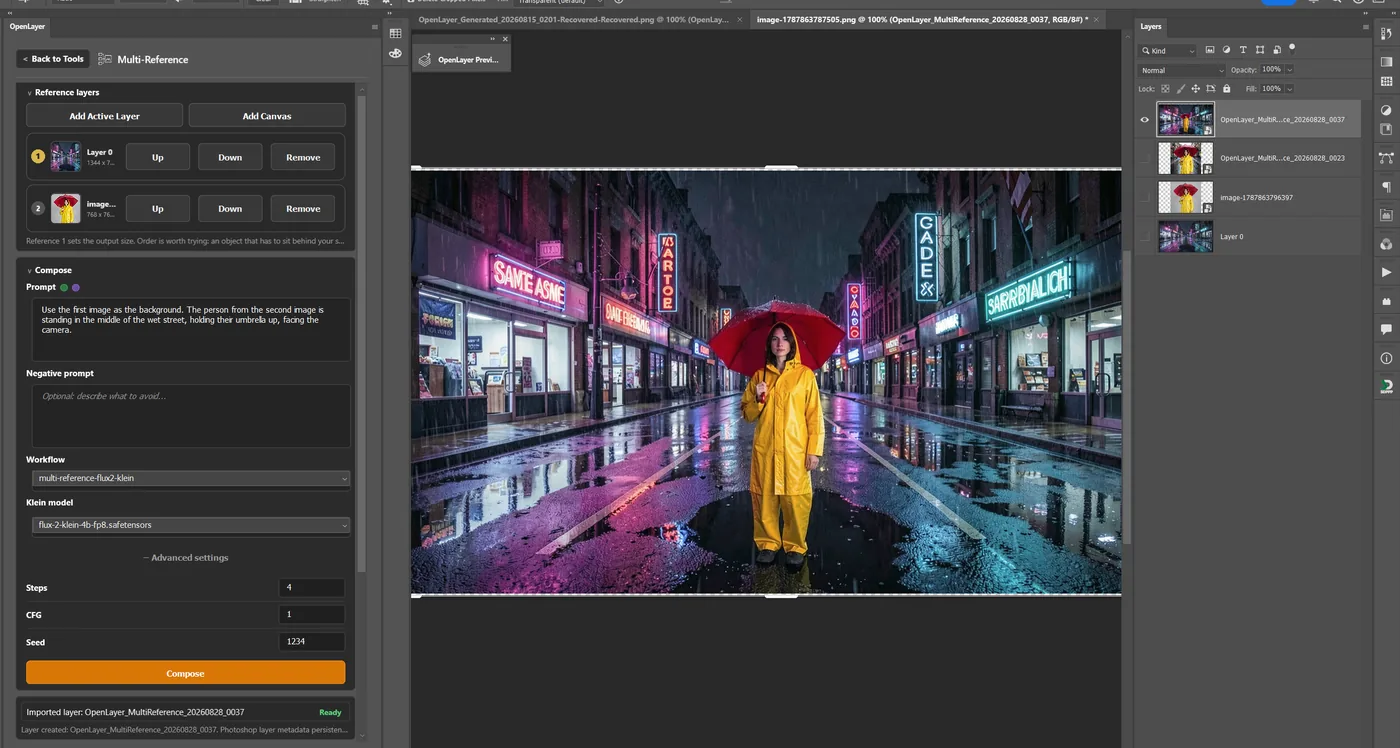
Capture the active layer or visible canvas as lossless PNG, reinterpret it with a prompt, and import the result — optionally automatically.

Sketch to Image

Experimental

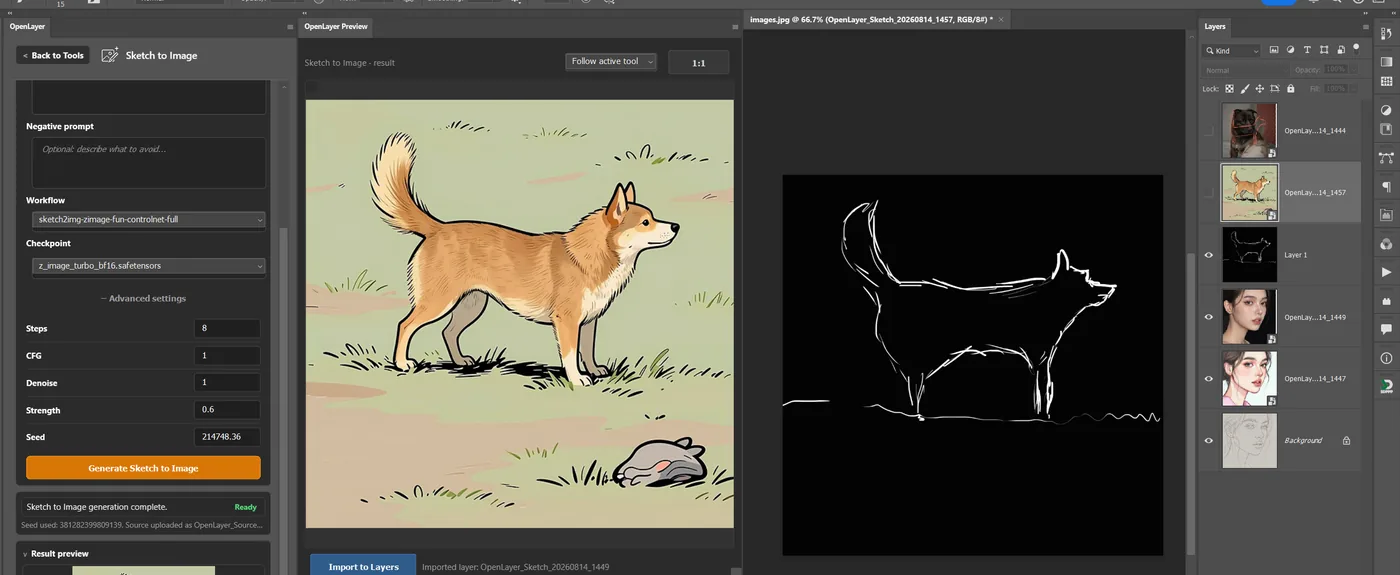
Guide generation with your linework through an SD 1.x LineArt ControlNet workflow, with adjustable control strength.

Inpaint

Experimental

Make a Photoshop selection, capture source and mask, repaint just that region with SD inpainting or Flux Fill, and import aligned to your selection.

Outpaint

Experimental

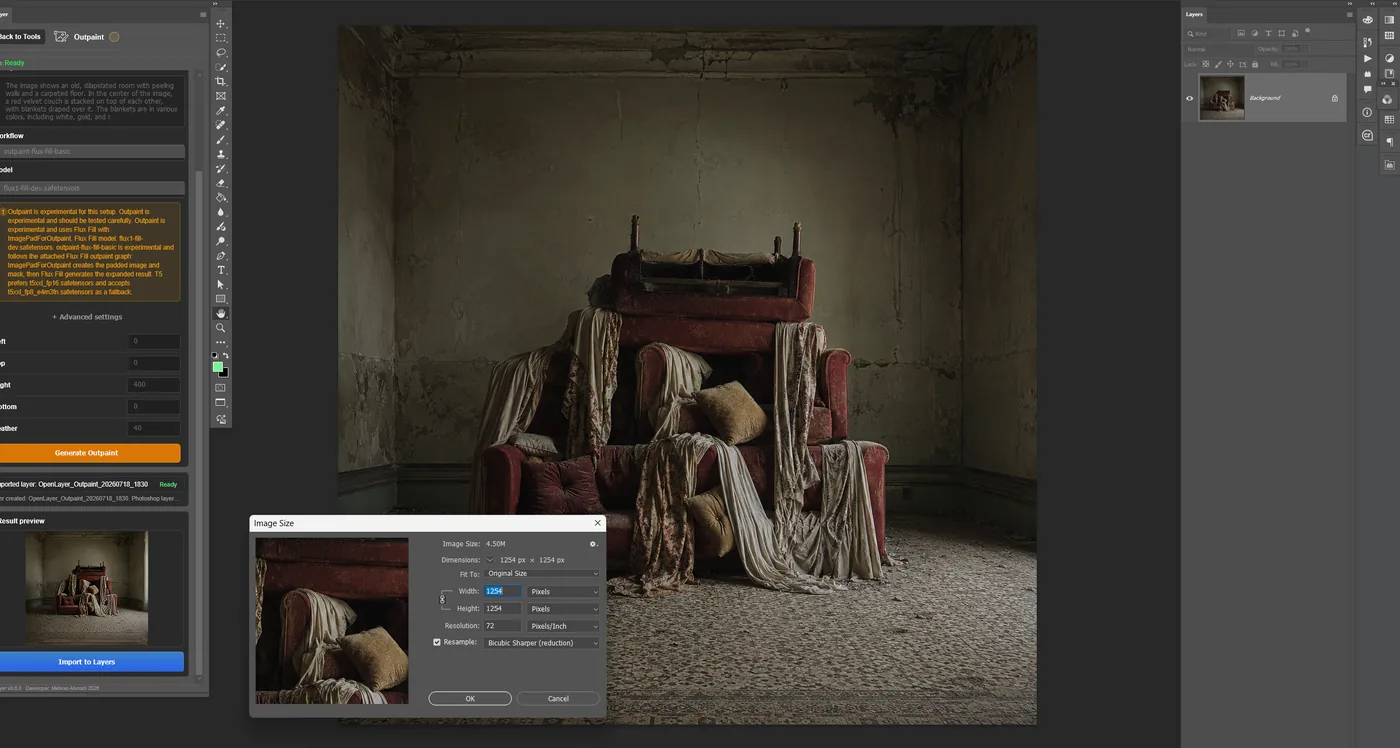
Extend content beyond the canvas edges with Flux Fill and per-edge padding and feathering control.

Upscale

Experimental

Enhance layers with local upscale models such as 4x-UltraSharp — fast pixel/model upscaling through ComfyUI.

Prompt from Layer

Experimental

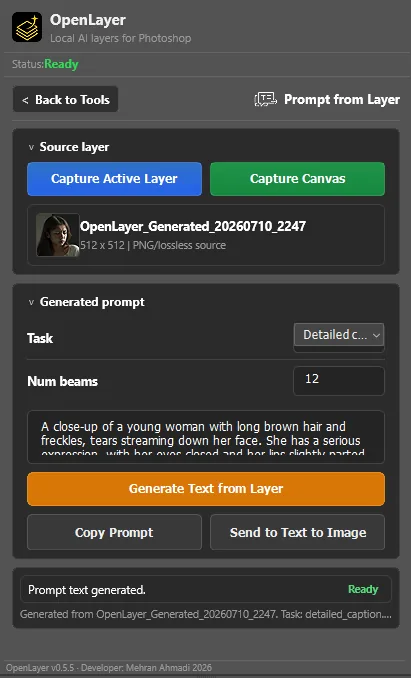
Describe any layer or canvas into editable prompt text with Florence-2 PromptGen, then send it straight to Text to Image.

Workflow Health

Built in

One click tells you which presets are ready on your ComfyUI — missing models, missing nodes, and beginner-friendly next steps.

More under the hood
  • Local ComfyUI connection with active-port discovery and one-click availability checks.
  • PNG/lossless source capture from raw Photoshop Imaging API pixels.
  • Live KSampler step previews streamed into the panel while generating.
  • Queue-aware Cancel Generation that never kills another client's job on a shared server.
  • GPU and VRAM detection with beginner-friendly model family recommendations.
  • Per-preset recommended defaults applied when you switch workflows.
  • Copy Diagnostics: a local, private setup report for bug reports.
  • Session history with prompt, model, seed, dimensions, source mode, and one-click Reuse Settings.
  • Experimental checkpoint mode with clear compatibility warnings for SD3, Flux, and Z-Image families.
  • Workflow compatibility foundation that separates checkpoint presets from diffusion-model-stack presets.
  • UXP-safe vanilla TypeScript interface — no fragile browser APIs inside Photoshop.
  • Typed AI-layer metadata foundation for future persistent, reproducible AI layers.

Current build · v0.6.0

Proof from the real Photoshop panel

Each view below is a real local workflow, compressed for the web and loaded only when it approaches the viewport.

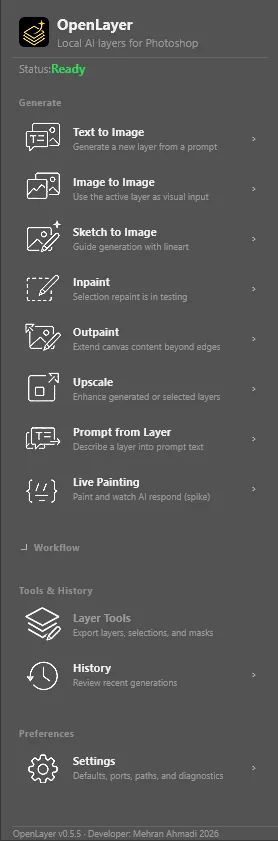
OpenLayer v0.6 compact dashboard with available, experimental, and unavailable tools clearly grouped.
The v0.6 dashboardA compact launcher keeps generation tools close, groups workflow and history utilities, and dims features that are not ready yet.
OpenLayer v0.6 Text to Image controls and generated comic preview.
Focused Text to ImagePrompt, model, sampler controls, status, preview, and import remain readable in a narrow docked panel.
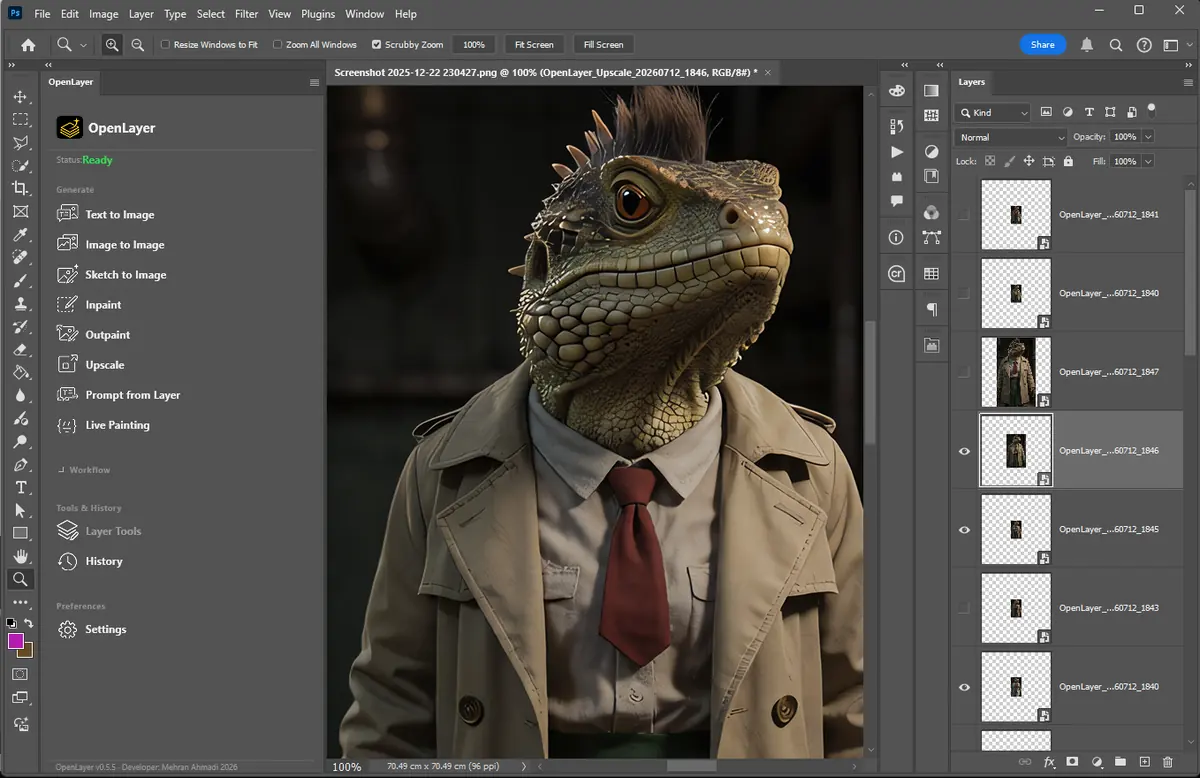
OpenLayer Upscale result displayed in Photoshop with generated layers visible in the Layers panel.
Upscale stays layer-nativeLocal model upscaling returns to the active document as a named Photoshop layer instead of a detached download.
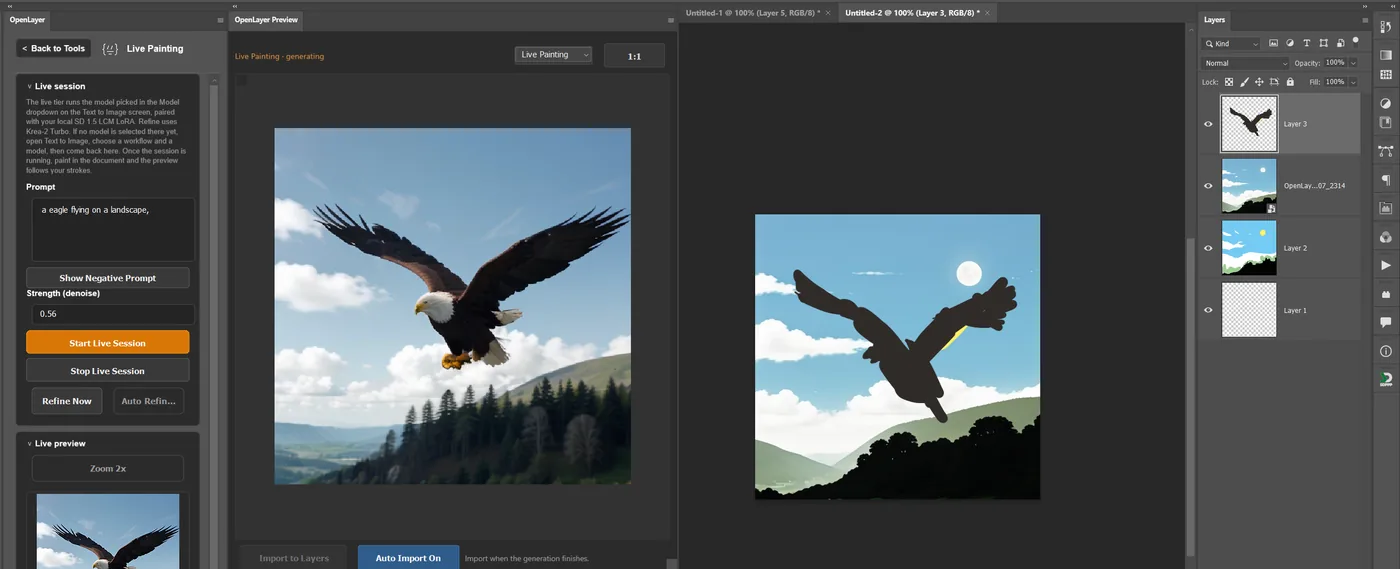
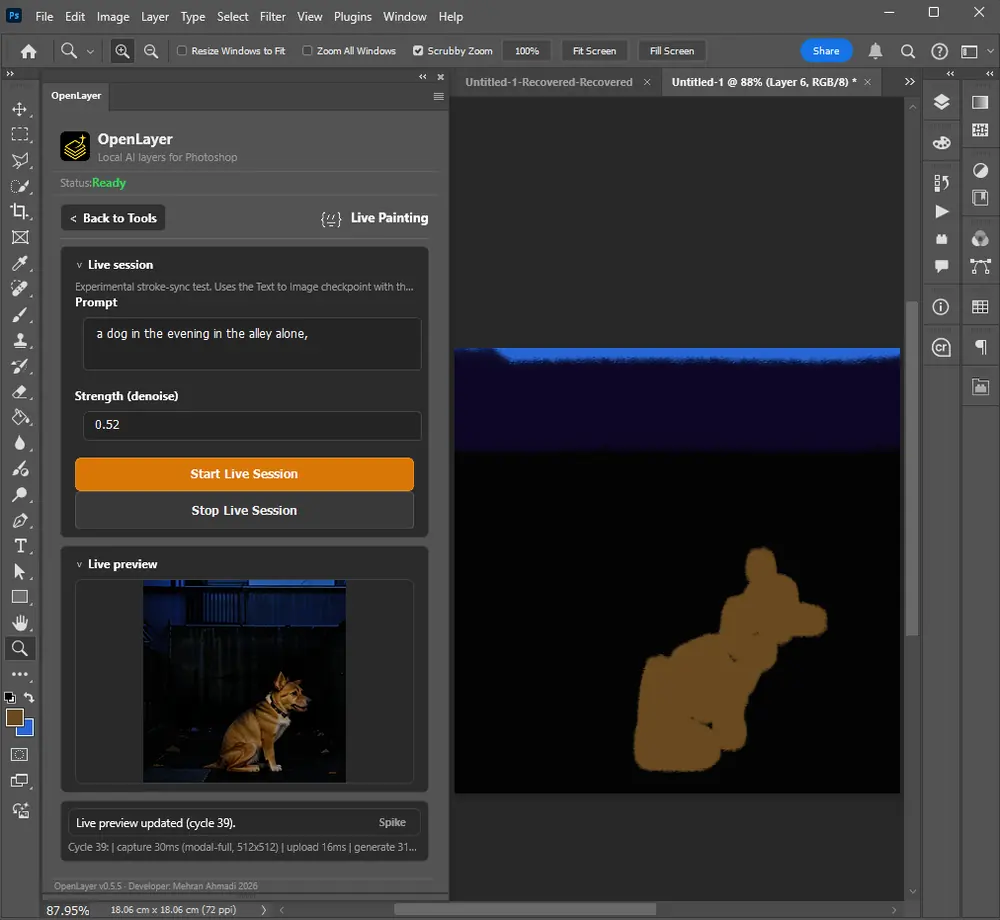
OpenLayer Live Painting with a sticky tool header and preview beside the active Photoshop canvas.
Context that stays pinnedThe v0.6 tool header keeps Back to Tools and the current workflow visible while longer panels scroll beneath it.
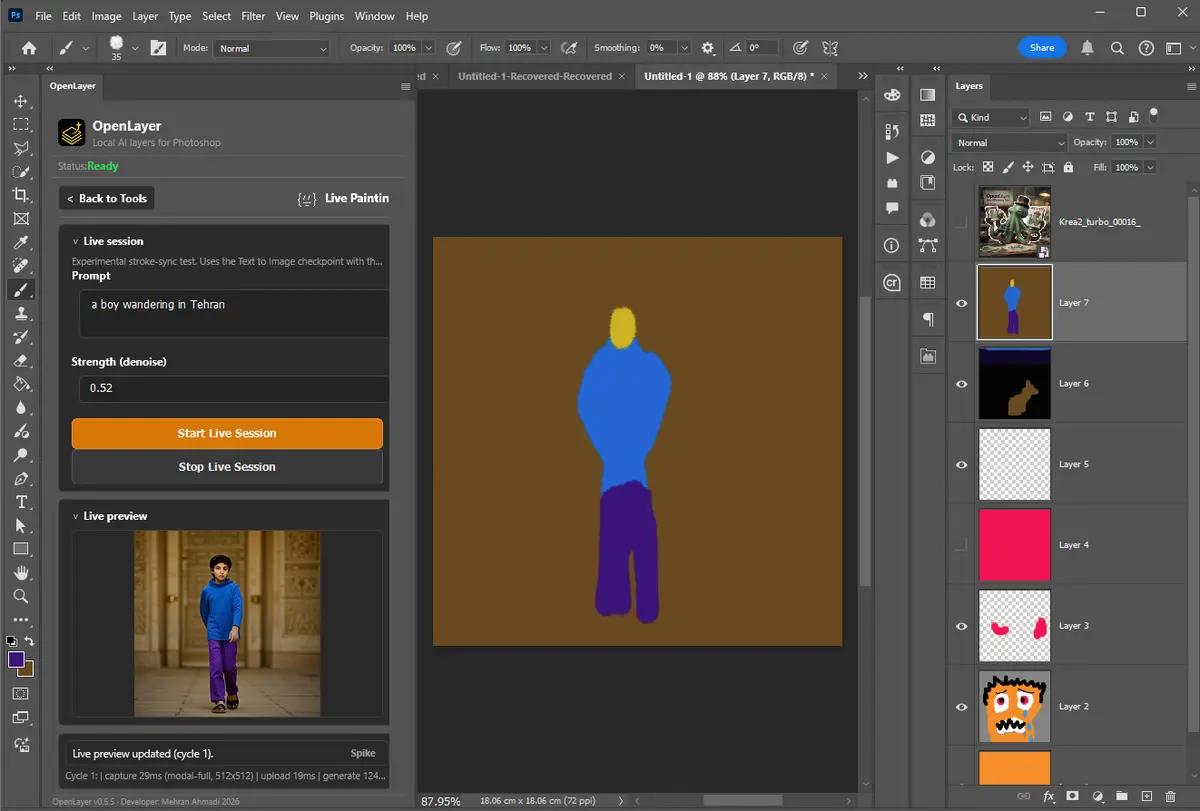
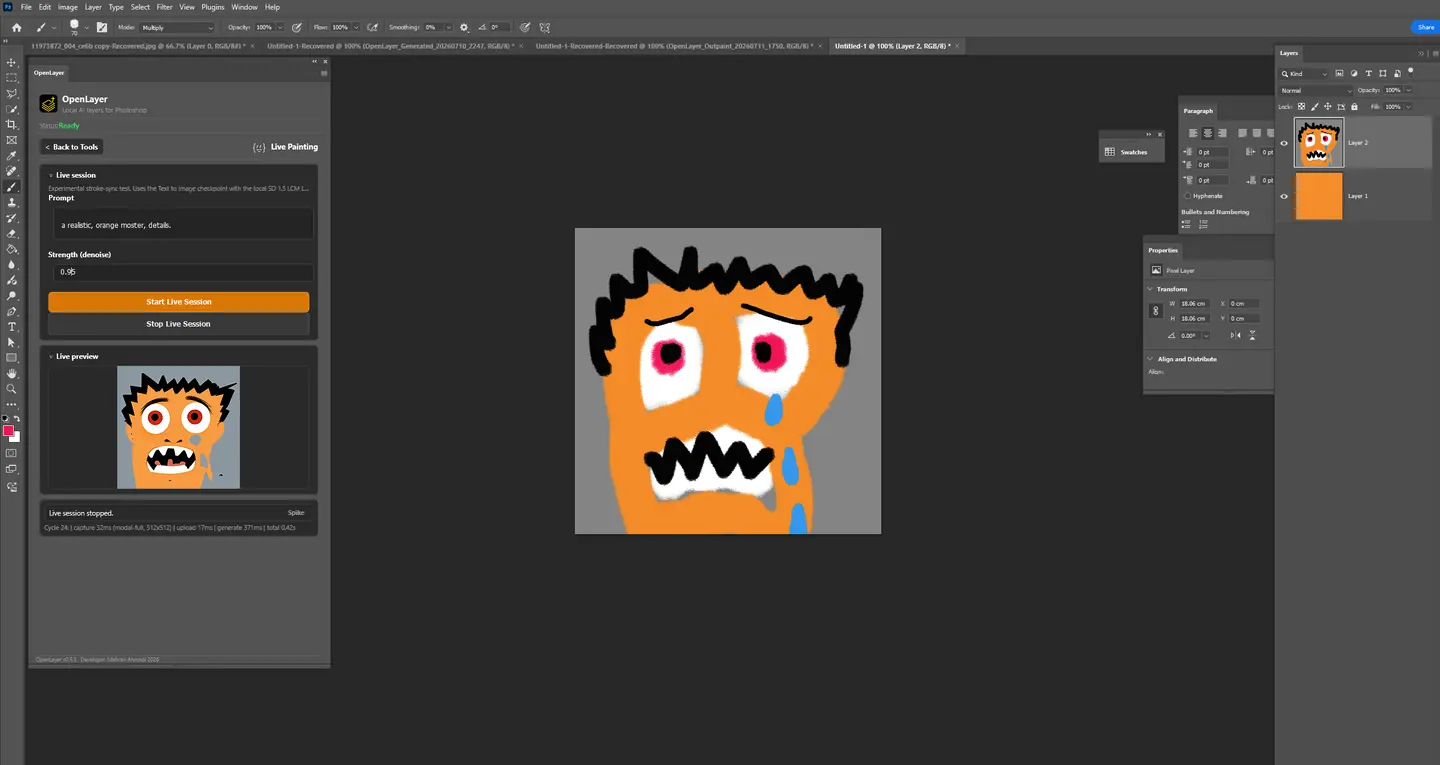
A simple painted figure in Photoshop transformed into a local AI preview through OpenLayer Live Painting.
Paint, capture, respondThe Live Painting spike turns rough color blocking into a local preview while preserving the Photoshop document as the source of truth.

Oldest to newest

How the OpenLayer interface evolved

The visual language stayed dark, local, and Photoshop-aware. Each release removed friction while preserving the original goal: make AI output behave like editable layer work.

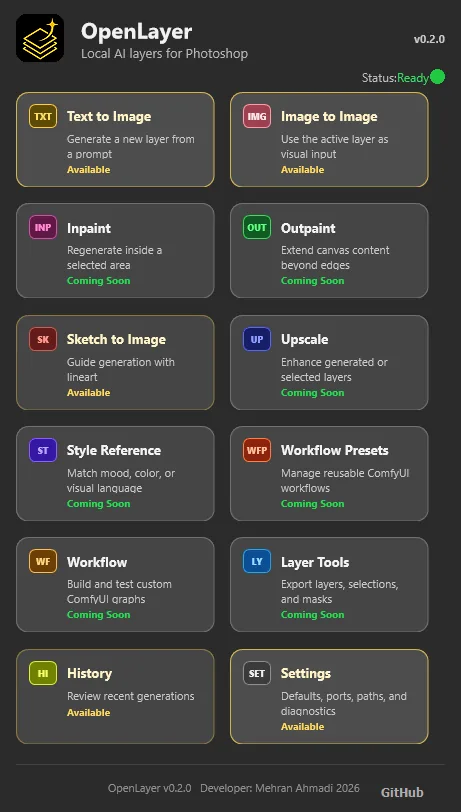
  1. Early OpenLayer dashboard with large tool cards and status badges.
    1 · The first launcherThe earliest README dashboard established the tool-card model and made unfinished workflows explicit, but used much more vertical space.
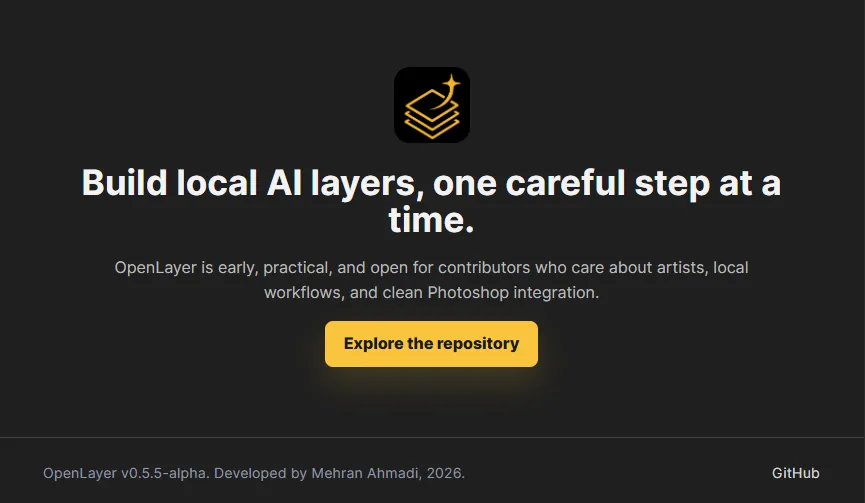
  2. Earlier OpenLayer landing-page closing section with the gold layered logo and project mission.
    2 · A durable visual identityThe black canvas, gold layer mark, and careful-step message became the design foundation retained by the v0.6 page.
  3. Earlier Prompt from Layer screen with captured image and generated description.
    3 · Workflows became complete screensPrompt from Layer connected capture, local Florence-2 description, editing, copying, and handoff to Text to Image.
  4. OpenLayer Live Painting turning a rough orange monster sketch into a local AI preview in Photoshop.
    4 · The panel began responding to the canvasThe Live Painting experiment proved that repeated local capture and generation could follow fast Photoshop sketch changes.
  5. Current OpenLayer v0.6 compact dashboard.
    5 · v0.6 compact UXP interfaceToday the dashboard is denser, clearer, and more honest about availability, with stable UXP typography and room for the next artist tools.

Workflow

How it works

  1. Run ComfyUI locally on the OpenLayer port (8190 by default).
  2. Open the panel in Photoshop and click Check ComfyUI.
  3. Pick a tool — capture a layer, canvas, or selection where needed.
  4. Generate and watch live sampler previews in the panel.
  5. Import the result as a new named Photoshop layer.

Setup

Run it locally in minutes

1

Install and build

npm install
npm run build
2

Load in UXP Developer Tool

Select the generated dist/manifest.json, click Load, then open the OpenLayer panel in Photoshop.

3

Start ComfyUI

python main.py --listen 127.0.0.1 --port 8190 --preview-method auto
4

Create the first layer

Check ComfyUI, choose a checkpoint, enter a prompt, generate, and import the result into the active document.

OpenLayer defaults to http://127.0.0.1:8190 so it can run beside other local tools that may already use port 8188. --preview-method auto enables live step previews.

Current alpha status

What this release is honest about

v0.6 interface is ready to test

The compact dashboard, sticky headers, real progress track, larger prompt fields, and unavailable-tool states have passed a real Photoshop UXP smoke test.

Testing alpha

OpenLayer v0.6.0-alpha is for local testing and feedback. It is not production-ready yet.

Inpaint is experimental

v0.6.0 retains the upload and alignment fixes while output quality across checkpoints continues to be validated by testers.

Flux Fill is experimental

Flux1-dev fp8 Text to Image, Flux Fill Inpaint, and Outpaint run locally but still need careful validation and tuning.

Custom workflows are future work

OpenLayer keeps API and source workflow folders, but custom workflow import and automatic node mapping are not built yet.

Honest alpha boundaries
  • txt2img-basic, img2img-basic, and sketch2img-linecn-basic are starter workflows, not final production presets.
  • Sketch to Image currently targets SD 1.x LINECN with epicrealism_naturalSinRC1VAE.safetensors and control_v11p_sd15_lineart_fp16.safetensors.
  • Custom ComfyUI workflows may need node ID updates in the preset registry.
  • GPU-aware recommendations are advisory only. OpenLayer does not auto-switch models or workflows yet.
  • Layer, canvas, and mask capture is limited to 16 megapixels until a downscale option is added.
  • Inpaint and Outpaint should be tested on duplicate layers first.
  • Prompt from Layer requires the local Florence-2 PromptGen model plus text-output custom nodes.
  • Upscale uses pixel/model upscale only. Generative upscale, tiled diffusion, and creative enhancement are future work.
  • Custom workflow import, LoRA browser, batch variants, and true persistent Photoshop AI layer metadata are future work. v0.6.0 keeps the shared metadata foundation and session-history wiring.
  • CI does not run Photoshop, UXP, or ComfyUI integration tests.
  • Live sampler previews require ComfyUI to be started with --preview-method auto.

Roadmap

Where OpenLayer goes next

v0.1–v0.2 · Foundation

Text to Image, preview, import, checkpoint selection, Image to Image, Sketch LINECN, source capture, and setup documentation.

v0.4–v0.5 · Working workflows

PNG capture, diagnostics, Prompt from Layer, Upscale, queue-aware Cancel, History metadata, live previews, and experimental Inpaint and Outpaint.

v0.6 · Compact UXP interface

A denser dashboard, sticky headers, determinate progress, Advanced settings, clearer availability, and prompt fields hardened in the real Photoshop renderer.

Next · Reliability and artist control

Finish Inpaint and Outpaint alignment, strengthen workflow validation, and turn the metadata foundation into repeatable layer-level iteration.

Future artist tools

Guided custom workflow import, ControlNet panels, LoRA browsing, batch variants, persistent AI layer metadata, and faster live-preview generation.

Build local AI layers, one careful step at a time.

OpenLayer is early, practical, and open for contributors who care about artists, local workflows, and clean Photoshop integration.
Explore the repository